We regret to pass along this sad news, El Negro Triana passed away yesterday, apparently from complications of asthma.
Below is a repost of a profile we did on him in February 2009.
Guillermo "El Negro" Triana Crespo Havana, Feb 2008 (photo: Barry Cox)
Guillermo Triana Crespo, known as "El Negro" was born on February 10 1940, at 212 calle Ángeles, between Corrales y Gloria, in Jesús María, Havana, just down the street from the Embale family. He was always there at the rumbas in their solar, they were like family to him. Guillermo was inspired to begin singing rumba by hearing Carlos Embale's older brother, Luis. He would sing with a group called Estrellas Amalianas, along with Lazaro Suazo, Roberto Carillo (a nephew of Tio Tom), and Chino "Mala Noche," now all passed away.
While El Negro is appreciated by everyone as an all-around rumba singer, equally adept at guaguancó, columbia, yambú and Abakuá, his preference is for voz tercera, the high harmony part in a vocal duo. He also enjoys creating arrangements, adapting songs from other genres such as boleros, splicing them together into a creation all his own.
El Negro has enjoyed a long and varied career. In 1965 he joined Pello El Afrokán's Mozambique group and later joined Luis "Aspirina" Chacón Medivel's group Sicamarié.
He also worked with Lacho Rivero in carnavales, and even worked as a music therapist in a psychiatric hospital.
In 1970 he began working with Carlos Embale, playing tumbador on the LP "Conjunto Guaguancó Carlos Embale."
Later he began working with the great Coro Folklórico Nacional, (initally formed by Ignacio Piñeiro), with whom he continues today.
He was married to the great rumba singer Zuzana Calzado until her passing several years ago.
He has also been called more recently to participate in groups with Pancho Quinto as well as Ventu Rumbero, working with Chavalonga, Fariñas and Román Diaz. GROUPS: -Grupo de Pello El Afrokán -Grupo Sicamarié -Grupo de Lacho Rivero -Grupo de Carlos Embale -El Coro Folklórico Cubano -Grupo de Pancho Quinto -Ventú Rumbero
Discography: Coro Folkórico Cubano "En un Solar Habanero" (Egrem 0424, 1991) Pancho Quinto "En el Solar La Cueva del Humo" (RWCD 9704, 1997) El Goyo: "La Rumba es Cubana - su Historia" (Unicornio UN-CD6004) Pancho Quinto "Rumba sin Fronteras" (Riverboat 2003) Clave y Guaguancó "La Rumba que no Termina" (2007)
Filmography: -DVD "Rumbambeo" (Boogalu Productions) de Santiago Garzón Rill "Chaguito"
Una vez fui a dormir Y soñé que un vuelo Un camino cogí Y de pronto me vi En la puerta del cielo Y en el cielo rumor De canciones venian Y una diana de amor Alivió mi dolor Que en mi pecho sentia
Pues bueno, Anoche estuve soñando Que al cielo me transportaba Apolo que me esperaba Me recibió improvisando Luego estuvimos hablando Luego estuvimos hablando Sobre de astrologia San José y San Fernando San José y San Fernando Con Jesus Cristo llegaron Y asombrado se quedaron De la improvisación mia María un beso me dió Timbero, María un beso me dió San José reza y suspira Apolo botó la lira Y Jesus Cristo me aplaudió San Isidro y San Fernando Mandaron a San Ignacio Que construyera un palacio Y el nombre mio llevara Para que yo administrara Y asombrado quedé yo Y asombrado quedé yo Del trato tan alagueño Solo sin saber que sueño Hacia el cielo me llevó
Y una vez me dormí...
Coro: Yo tuve un sueño feliz, y quise hacer una canción
Coro: Pa' que me mira con malos ojos, si malos ojos no mata a nadie
Last year, musician, artist and collector Myron Ort posted on his website what we believed were likely to be the first recordings of traditional rumba (that is, rumba with only voice and percussion), by Carlos Vidal Bolado, under the name "Vidal Bolado y su ritmo de tambores" (SMC Pro-Arte 2519, 2520).
In this article we'll attempt to summarize our research so far about these and other early recordings of traditional Cuban rumba up to 1956, and provide a comprehensive overview of the discography. Percussionist David Peñalosa and I have been evaluating many of these recordings and we will be elaborating on them at a later time.
Part One: Rumba in the earliest days of recording. In one form or another, rumba has been a presence on Cuban recordings since nearly the beginning of the recording industry there (Reyes 2000). References to rumba, "rumberos", rumba melodies, and song titles suggestive of rumba melodies or conventions are legion.
Unfortunately many of these early recordings are unavailable for listening. (Díaz Ayala (1994:16) estimates that only 15 to 20 percent of the music released on 78 was transferred to LP.) However we have posted examples where we are fortunate enough to have a reference.
Following are selections (from a much longer list) of recordings through the 1920s which reference rumba or contain rumba melodies. (Most of these recordings are referenced in Díaz Ayala 1994.)
1899 - Los Rumberos. Arturo B. Adamini. (Edison cylinder 4247) First known reference to rumba on record. This performance is most probably related to the rumba of the teatro vernáculo or variedades, a popular form of theater entertainment in Cuba at the time, where performers, often in blackface, performed "rumbitas" after comedy routines often featuring "negritos" "gallegos" and "mulatas." The word "rumba," in the context of the teatro vernáculo was used very loosely to say the least.
The term rumba was apparently used by variedades musicians to refer to any sort of lively, uninhibited movement on stage during the finale. The few existing recordings of "diálogo y rumba" form the Cuban popular theater similarly demonstrate that, as in the case of dance, virtually any musical composition could be described as rumba...variedades rumba was influenced stylistically at least as much by Italian light opera as by Afrocuban non-commercial musics. In many cases it incorporated virtually none of the characteristics associated with the latter (Moore 1995:174).
While we haven't heard this particular recording, this song of the same title from 1928, by Italian tenor Tito Schipa & the American Emilio De Gogorza (Victor 1751) could be similar:
"Los Rumberos" (1928) Tito Schipa and Emilio de Gorgoza Victor 1751
1907 - (July) La Rumba. Orquesta Típica Velázquez. (Victor 12" 99023) First appearance of the word "Rumba" on a record label. Recorded in Mexico, the genre is listed as "Danzón Veracruzano."
1913 - La Rumba. Victor Military Band. (Victor 10" 17439) Another early appearance of "Rumba" on a record label. Genre is listed as "Tango."
Click below to listen:
As is the case with the previous examples, besides the title this recording obviously has little to do with rumba as we think of it today. Still, it is instructive to see the varied contexts in which the term "rumba" has historically been used. Additional information about this recording can be found here.
1916 - (October 18) Lo Típico de Cuba. Terceto Nano. (Victor 10" 72783) Earliest attribution of Ignacio Piñeiro (1888-1969) as composer; genre is listed as "rumba." Ignacio Piñeiro is well-known today as one of Cuba's preeminent composers of guaguancó and sones, and he would later participate in one of the first recordings of traditional rumba in Cuba.
1916 - El Edén de los Roncos. Orquesta Reverón. (Victor, no number) The composer of this danzón is listed as Ricardo Reverón. Recorded but never released, this is most likely a version of the guaguancó today attributed to Ignacio Piñeiro.
1918 - Guaguancó. Orquesta Reverón. (Victor 68558) First known appearance of the word "guaguancó" on a record label. A danzón with ABACADAE structure, none of the melodies used appear to have any relationship to guaguancó or rumba (Díaz Ayala 2006:123).
Click to hear "Guaguancó" by Orquesta Reverón (Danzón, 1918) Victor 68558
Stretching to make some sort of connection, one could start speculating from the fact that danzónes tend to save the title theme for the last, which in this case starts at about 3:20.
This theme starts out with a three-note motif (tresillo), which could conceivably carry the lyric "gua-guan-có." Later the same motif appears paired with another note, which could be "el" or "mi."
1920 - Se acabó la rumba. Orquesta Felipe Valdéz. (Victor 72759) Probably the first danzón to feature vocals, this is a version of the guaguancó better known as "La Última Rumba." Reissued on "Early Cuban Danzón Orchestras 1916-1920" Harlequin CD 131.
c. 1920 - El yambú guaguancó. María Teresa Vera y Manuel Corona. (Columbia C3557) As Díaz Ayala has noted (2006:124), this could be considered the first recording of a traditional rumba.
Click to hear "El yambú guaguancó" c. 1920 by María Teresa Vera and Manuel Corona Columbia C3557
The song structure is typical of yambú or older rumbas, starting out with a sung wordless chorus, alternating with a soloist who sings cuartetas. In this case the soloist is María Teresa Vera (1895-1965), and among her cuartetas she sings:
"Hay muchas conozco yo que de sus males tienen culpa y que le dan por desculpa que el diablo les castigo"
The chorus then returns, this time with the familiar introductory melody today known as "Ave María Morena," or in some cases simply "Yambú." The cuartetas continue, including the familiar:
"Mi padre con cinco estrellas no pudo ser general y yo con una estrella y media hago la tierra temblar."
The chorus then returns to sing "Ave María Morena," with Vera singing another familiar cuarteta:
Un jardinero de amor siembra una planta y se va otro viene y la cultiva ¿De quién de los dos será?
Although this recording features guitar, the melody, the style of singing, the claves and the style of the percussion instrument's (which could be a bongó, tack-head drum or even a cajón) soloing strike us as all pure rumba de solar.
Many of María Teresa Vera's earliest recordings feature rumba melodies which are still in the rumba repertoire today. Some of them can be heard on "El Legendário duo de la Trova Cubana" Tumbao CD 090.
Part Two: The earliest recordings of traditional rumba 1941-1956. In this section we will summarize what we know about the earliest recordings of "traditional" rumba, that is, vocals with only percussion instrumentation.
1937/8 - Tam Tam, o el origen de la rumba. (Directed by Ernesto Caparrós, BW, 22 min.) Although never released on disc, the earliest recorded documentation of authentic Cuban rumba we have been able to find is from this short film, and we felt it deserved mention here. It features a short segment of a rumba shot in a nightclub, said to be the Edén Concert, at 28 Zulueta street in Havana. (de Palacios, 1988). A trumpet can be heard soloing briefly in the first part, but for most of the segment only voices and drumming are heard.
Click to view clip from "Tam-Tam: O el origen de la rumba" Dir. Ernesto Caparrós, 1937 or 1938
The rhythm played is a quite fast guaguancó, a style that is sometimes referred to as "jiribilla," while the male and female dancers both dance columbia simultaneously. At one point, an actor or dancer portraying a drunken patron joins them, and begins dancing with movements reminiscent of the íremes of Abakuá, while the woman takes his glass and dances with it balanced on her head, a common act in rumba cabaret acts of the time.
1941 - Harold Courlander records rumba, guaguancó, yambú, conga in Havana. Archives of Traditional Music, Accession Number 54-058-F EC 8178 item 5 - Conga EC 8180 item 7 - Guaguancó EC 8180 item 8 - Yambú EC 8192 item 6 - Rumba
Harold Courlander (1908-1996) was an American novelist, folklorist and anthropologist who specialized in African and African Diasporic cultures, particularly in Haiti. His trip to Cuba was sponsored by the American Council of Learned Societies, in cooperation with Columbia University’s Archive of Primitive Music. He is well-known for having made the first field recordings of Afrocuban folkloric music, a small fraction of which were released in a 78rpm album (Disc New York, ca 1947) and LP (Ethnic Folkways Library P-410).
The liner notes to the Folkways release state that the recordings were made in 1940, but Courlander wrote two separate articles (Courlander 1942; 1984) referring to his Cuba trip as having taken place in 1941.
A complete copy of all 10 hours are at the Archives of Traditional Music ("ATM") in Bloomington, Indiana.
We will explore Courlander's recordings further in a later article. For now we will present "EC 8180 item 7," what we believe to be the earliest recording of guaguancó played in the traditional style.
Click to hear a guaguancó recorded by Harold Courlander in Havana, 1941. Probably of Alberto Zayas and Lulu Yonkori From The Archives of Traditional Music, EC8108, item 7.
Although the recording is not of optimal quality, we can hear quite clearly the voice of Alberto Zayas as the "inspirador," leading the chorus with his dianas and floreos. Zayas was a major informant of Courlander's. (Although in Courlander's writings he is evidently sometimes mistakenly called "Alfredo," as even some of Zayas' recorded releases do (see Díaz Ayala ....).
As best we can determine, the lyrics are as follows:
Archives of Traditional Music Harold Courlander Accession Number 54-058-F EC 8180 item 7 - Guaguancó
Yayoestoydesengañado de lo que es la humanidad, Yayoestoydesengañado de lo que es la humanidad [de poder] vivir A mi no me engaña más que él que yo quiera
Si acaso muero, es por mi instinto natural. (bis) (El hombre, caballero, O, yayoestoydesengañado ¡De nuevo! ¡De nuevo, de nuevo, de nuevo! Vamo', a, cantor, olá ¡Dáselo!)
Yayoestoydesengañado de lo que es la humanidad (bis) de poder vivir. A mi no me engaña más que él que yo quiera
Si acaso muero, es por mi instinto natural. (bis)
(El hombre, el hombre, el hombre, el hombre, Vamos a ver, Olá, olá)
El hombre, sin zapatos, sin calzones, sin sombrero, si tiene la [...] como estoyyo no vale nada en la sociedad (bis)
(Cuando tenga, vamos a ver, olá)
Cuando tenga un sombrero [...] a cantar, a cantar (Llámalo) [...] la vida [...] la realidad
Coro: Bobo eke na' ma'
The group is obviously professional and well-rehearsed, and was probably an early incarnation of Zayas' group Lulu Yonkori.
1946 - Bill Abel of Coast Records travels to Havana, to record "genuine Afro-Cubano rumbas" for Peerless Records. We are unaware of any recordings that resulted from these sessions.
In 1947 Katharine Beardmore recorded some examples of drum rhythms for various styles. We know little about her. She was possibly Canadian, signing one letter "c/o the Royal Trust Company, Ottawa, Canada." We have not heard these recordings, but she appears to have made what could be considered the first instructional records for rumba:
"The music played in these records is normally accompanied by songs and dances. The purpose here, however, is to give examples of rhythm alone for students interested in this study. In the case of the Guaguancó, the Lucumí, and the Conga, the rhythms of each instrument are introduced separately at first to facilitate their analysis, and then the instruments are played together. In these instances, the instruments come in in the following order: claves, quinto, tumbador, conga, jimagua." (Beardmore 1947).
The Library of Congress describes these recordings as follows:
AFS 8562-8567: Six 12-inch discs of drum rhythms of five Afro-Cuban popular dances (columbia, comparsa, conga, guaguancó, and lucumí) and one example of combined rhythms played by an ensemble of five musicians. Recorded possibly in Havana, Cuba, by Katharine Beardmore, ca. 1947-48. The collection includes eight pages of correspondence, descriptions, and lists. (Twenty-two minutes; tape copy on LWO 5111 reels 121B-122A)
In a 1947 letter to Duncan Emrich of the Archive of American Folk Song, Beardmore proposes a rather extensive recorded collection of Afrocuban music (but no rumba), to be directed by Fernando Ortiz. We do not know whether any of these recordings were ever undertaken, but it seems similar to the project that was later carried out by Josefina Tarafa and Lydia Cabrera in 1955 (Beardmore 1947).
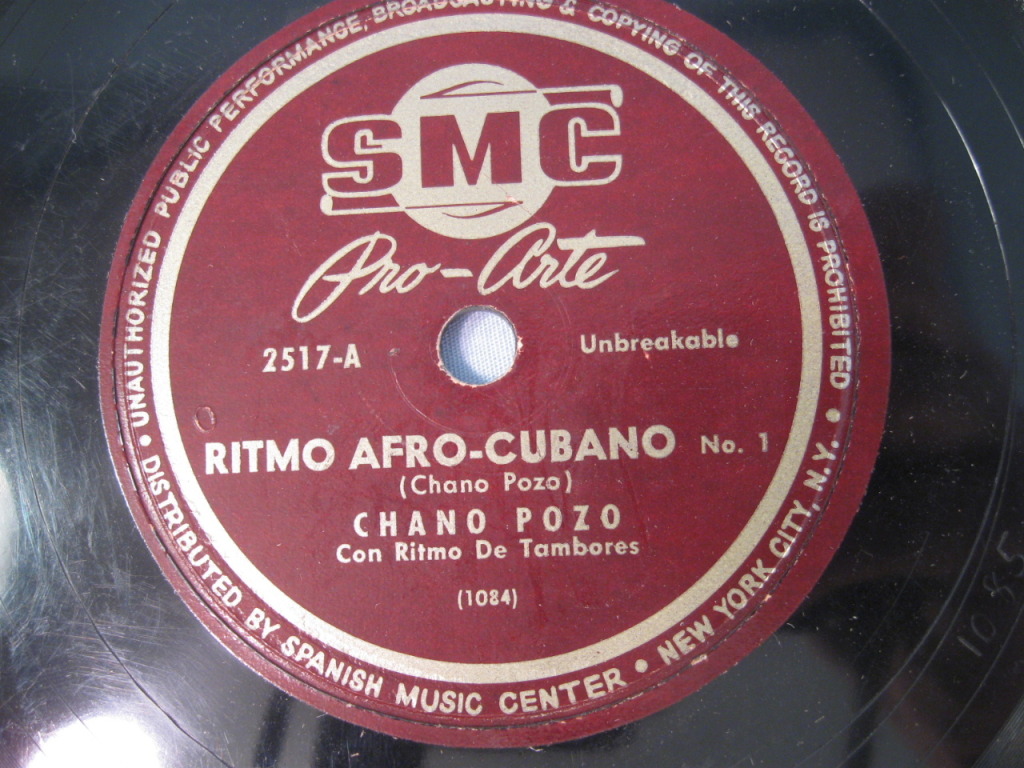
1947 - 1949 (?) - Chano Pozo and Carlos Vidal record for SMC-Pro Arte in New York City. SMC Pro-Arte 2517-A Ritmo Afro-Cubano No. 1 ["Ya No Se Puede Rumbear"] SMC Pro-Arte 2517-B Ritmo Afro-Cubano No. 2 ["Abasí"] SMC Pro-Arte 2518-A Ritmo Afro-Cubano No. 3 ["Tambombararana"] SMC Pro-Arte 2518-B Ritmo Afro-Cubano No. 4 ["Placetas"] SMC Pro Arte 2519-A "Ritmo Afro Cubano No. 5 ["Columbia"] SMC Pro Arte 2519-B "Ritmo Afro Cubano No. 6 ["Santo"] SMC Pro-Arte 2520-A "Ritmo Afro Cubano No. 7 ["Abakuá"] SMC Pro-Arte 2520-B "Ritmo Afro Cubano No. 8 ["Guaguancó"]
The earliest known studio recordings of traditional Cuban rumba were made in New York City by Gabriel Oller's SMC Pro-Arte label. Chano Pozo (1915-1948) recorded four sides on February 7th, 1947. Personnel were Chano Pozo, Miguelito Valdés and Kike Rodríguez (congas and vocals), Carlos Vidal (congas) and José Mangual (bongó) (Pujol 2001).
Apparently with the intent of releasing an "album" (consisting of four 10" 78 rpm discs), Oller also released four numbers from a session headed by Carlos Vidal Bolado (1914-1996). The date and personnel on this session are unknown.
So for some reason, the recordings sat unreleased for two years, through a general recording strike that lasted most of 1948, and Chano's death in Harlem on Dec. 2, of that same year. The Chano Pozo sides begin to appear in the listings of Latin American releases in Billboard magazine of Feb. 5, 1949.
From Billboard Feb 5, 1949.
The Vidal tracks were probably released only in mid-to-late 1949, as part of an album called "Voodoo Drums" (SMC 5):
A review of this album appeared in Billboard's edition of November 26, 1949:
Some of the Chano sides were later re-issued on LP and eventually all of them on CD (Tumbao CD 305) but the Vidal Bolado recordings remained extremely rare, never having been reissued in any other format. The Vidal Bolado recordings can be heard here.
1948 (?) - Silvestre Méndez records "El as de la rumba" for Musart. Silvestre Méndez has said that the first recording he made after arriving in Mexico in 1946 was "El as de la rumba" for Memo Acosta's Musart label:
"...y ahí está en el coro el Gallego de Matanzas, y está el Melón y el Chocolate, Antonio Díaz, entonces yo lo grabé en ritmo de guaguancó auténtico como lo compuse, la rumba auténtica de Cuba; después tuve la ocasión de ver a Machito la primera vez que fui a Nueva York y se lo di a él y lo grabó." (Martré 1997:48)
"...and in the chorus there is el Gallego de Matanzas, and Melón, and Chocolate, Antonio Díaz, and so I recorded it as an authentic guaguancó like I composed it, the authentic rumba of Cuba; later I saw Machito on my first trip to new York and I gave it to him and he recorded it."
Musart was founded in 1948, so this recording must have been made sometime after that date, and before Machito's recording in 1958. Silvestre Méndez would later record several early rumbas, but as of yet we have not been able to locate this traditional rumba version of "El as de la rumba."
1948 - William and Berta Montero (Bascom) record a columbia in Matanzas. Archives of Traditional Music, Accession number: 72-261-F ATL 5391; Track 2 item no. 3 - Columbia 1948 - Richard Waterman records 14 rumbas in Regla. Archives of Traditional Music, Accession number: 72-087-F EC 10" 969 Item no. 8, 5A - Guaguancó ["Cállate tu"] (July 28, 1948) Item no. 9, 5B - Columbia ["Boku boku"] Item no. 10, 6A - Guaguancó ["El Tasajero"] Item no. 12, 7A - Guaguancó ["Que sentimiento me da"] (July 28, 1948) Item no. 13, 7B - Guaguancó ["Julio Guzmani inspirador"] Item no. 14, 8A - Guaguancó ["Dicen que soy un borracho"] Item no. 15, 8B - Columbia ["Soy Uriabón"]
EC 10" 970 Item no. 1, 9A - Columbia ["Soy el primer caminante..."] (July 28, 1948) Item no. 12, 15B - Columbia ["Blen blen blen"] Item no. 13, 16A - Guaguancó - ["Yo tengo que mudar"] (July 28, 1948) Item no. 14, 16B - Guaguancó - [Yo tengo que mudar] (cont'd)
Berta Montero and Richard Waterman in Cuba, c. 1946. Source unknown, clipping courtesy of Dr. Kevin Yelvington.
In the summer of 1948, four anthropologists from Northwestern University went to Cuba to conduct field research. They were David W. Ames, William Bascom, Berta Montero (later Berta Bascom), and Richard A. Waterman.
During their stay, Bascom and Montero alternated between Havana, Matanzas, Jovellanos, and other places to study Ifá and Santería; Ames settled in Vedado to conduct research for his article "Negro family types in a Cuban solar;" and Waterman settled in Regla, across the bay from Havana.
Influenced by Melville Herskovits' interest in the search for Africanisms in the Americas (Waterman 1988), Waterman and the Bascoms made many recordings of all types of music during this trip. The Bascoms focused mostly on lucumi and palo, but Waterman recorded everything from children's songs to Palo Monte. Copies of all of these recordings are stored at The Archives of Traditional Music. (They even shot color film during the trip, which we look forward to locating some day.)
William Bascom left over 300 single-spaced typed pages of field notes of his 1948 trip to Cuba. Unfortunately there is no mention of any of the nearly 3 hours of recordings at the ATM (Bascom 1948). On many of the tracks a woman's voice can be heard prompting the informants to start recording or identify themselves, etc., which suggests that the recordings may have been directed by Berta Montero.
Richard Waterman began recording rumbas in the Puerto Nuevo section of Regla on July 28, 1948. We have so far been able to locate his field notes only from the period of July 13-21st (Herskovits, N.d.). However, from the scarce documentation included with the discs we know the names of some of the participants: Alberto Brito, Felix Díaz, Julio Guzmani, and Gilberto Hernández.
We have learned that Alberto Brito was the father of Reinaldo Brito, composer of the guaguancó "El Niño Rey." Reinaldo states that his father worked in the "Oriente Industrial" slaughterhouse at Línea and E streets in the Lawton Batista district of Havana. He was also "obonekue" (initiate) of the Abakuá Potencia Uriabón Brandi Mosongo Efí Enmemoro (Hernández, 2011).
The Waterman rumbas are significant because as opposed to the flashier "cabaret" style of rumba frequently heard on early recordings, they allow us to hear rumba as it was played by and for rumberos of the day. There is a casual feel, and the instrumentation consists of spoons, bottles, boxes and the occasional drums.
Obviously our research on these recordings is ongoing, and we will have more to say about them at a later date. For now, we will present the first rumba Waterman recorded:
Archives of Traditional Music, Accession number: 72-087-FEC 10" 969Item no. 8, 5A - Guaguancó
Hay quien tiene, Hay quien tiene su warará (bis) Sabiendo que nunca el vulgo su secreto va a saber (bis) Pero yo, qué me acuesto de madruga' Pero yo, qué me acuesto de madruga'
Me entero de todo el chisme sin que nadie me lo cuente (bis)
Y me callo porque soy hombre discreto Y me callo porque soy hombre discreto
An dan dan dan dan etc.
[Se repite la canción]
Y me callo porque soy hombre completo Y me callo porque soy hombre completo
Coro: Cállate tu, mira que soy Abakuá
About the term "wárárá," Ivor Miller has linked it to the Abakuá term "Awárandária." He writes:
"In a rumba context, wárárá means "to play": it is a code referring to a group of men who live in peace, who get along well, enjoying debates about the richness of their cultural history, because they have mystic bonds as Abakuá members." (Miller 2006:164 and notes.)
So we can translate the lyrics as:
"There are those who have their Abakuá group knowing that the common people will never know their secret
But me, I stay up late, I learn all the gossip without anyone having to tell me
But I stay quiet, because I am a discreet man But I stay quiet, because I am a complete man
Chorus: Be quiet, you - I am Abakuá!
The song at once celebrates the bonds and benefits of Abakuá membership, the dignified manner expected of an Abakuá, and also issues a subtle challenge - be careful what you say about an Abakuá member.
1948-1949 - Filiberto Sánchez records Panart and RCA Victor in Cuba. Panart 78 1196-A "Atájala que se va (Columbia)" (1948) Panart 78 1196-B "Acere Ecobio (Ñáñigo)" (1948) RCA Victor 78 23-1254-A "Ocamanllé (Canto Negro)" (1949) RCA Victor 78 23-1254-B "Tumbador (Rumba Negra)" (1949)
The first studio recordings of rumba made in Cuba were recorded by Filiberto Sánchez.
Panart 1196
RCA Victor 23-1254 Images courtesy Matt Dillon
Released in 1948 and 1949, to our knowledge they have never been reissued in any other format. We obtained copies from the collection of Matt Dillon.
Besides being the first recordings of rumba made in Cuba, they also may be Cuba's first studio recordings of traditional Abakuá music.
Filiberto Sánchez was a percussionist from the Cayo Hueso neighborhood of Havana who worked as a percussionist for numerous groups such as Jóvenes del Cayo, Orquesta Casino de la Playa, Orquesta Adolfo Guzman, Cabaret Tropicana, La Mil Diez con Enrique Pilderot, and RHC Cadena Azul. (Sánchez, Jr., 2011)
In the 1940's he played tumbador with Agustín "El Bongosero" Gutierrez on bongó and vocalist Abelardo Barroso in La Banda de Música de la Policía (Petinaud Martínez, n.d.).
His son, Filiberto Sánchez Jr., is currently timbalero with Buena Vista Social Club.
Click to hear "Atájala que se va," by Filiberto y su ritmo Panart 1196 (1948)
"Atájala que se va"Filiberto y su ritmoCantan: Tata y VegaPanart 1196
Llamé, llamé, llamé Llamé, llamé, llamé No supiste compreender Mujer, mujer, mujer tu no tienes corazón
Tanto como la quería Tanto como la quería no me supo compreender lo que yo quería saber lo malo que ella me hacía
Coro: A e
Coro: Atájala que se va
"Atájala que se va" is listed as a columbia on the label but the rhythmic accompaniment is clearly a guaguancó. The song structure is an old style rumba, a short refrain sung by a chorus, repeated after a soloist recites a cuarteta.
Click to hear "Tumbador"
by Filiberto Sánchez y su ritmo "Abacuá" RCA Victor 1254 (1949)
"Tumbador"Filiberto Sánchez y su ritmo "Abacuá"RCA Victor 1254
Los rumberos están diciendo que la rumba está pa' gozar (bis)
La timba se ha puesto buena, el quinto y el tumbador ¡A gozar, a rumbear!
Coro: Ay, ay, ay, que bueno está mi rumbón
The song here is very simple, One remarkable aspect of "Tumbador" is that in the montuno section, at about 1:25, someone begins singing inspirations in a sort of mock-drunken English:
"Hello, hello, brother, helloooo! Meanwhile Cubans are gonna give you new style! C'mon and get my stuff now, I'm gonna do it for you!"
Cristóbal Diaz Ayala suggests these lines may be cabaret Dandy Crawford, a Cuban performer of Jamaican origin known for singing in English.
At 2:15, the solista sings "Agustín el Timbalero, rayas tiene en el bongó," right before a quinto solo. This suggests that Agustín "el Bongocero" Gutierrez is present on the recording, which would not be surprising given his known association with Sánchez.
Many questions remain about these recordings, and our research is ongoing.
1949 (?) - Juan Liscano records 5 rumbas by Cuban ensemble "Conjunto El Niño." Library of Congress Cuban and Cuban American Collection AFS 9907A3-B1: One disc containing two rumbas. (Seven minutes; tape copy on LWO 5111 reel 278B) AFS 9909A1-A2, B2: One disc containing three rumbas. (Eleven minutes; tape copy on LWO 5111 reel 279A)
Another set of recordings in the Library of Congress of particular interest, but which we have as yet not heard, is the Juan Liscano collection.
The full listing in the Library of Congress reads as follows:
AFS 9907-9909: Three 16-inch discs of Cuban and Venezuelan instrumentals and songs recorded by Juan Liscano before 1950. The collection includes eight pages of descriptions and lists. The Cuban examples consist of claves, drums, male chorus, rhythm stick, and solo male vocalist.
AFS 9907A3-B1: One disc containing two rumbas. (Seven minutes; tape copy on LWO 5111 reel 278B)
AFS 9908B1-B2: One disc containing two Afro-Cuban religious songs. (Seven minutes; tape copy on LWO 5111 reel 278B)
AFS 9909A1-A2, B2: One disc containing three rumbas. (Eleven minutes; tape copy on LWO 5111 reel 279A)
Dr. Kenneth Bilby (Personal comm. 2011) believes that these recordings are of a Cuban group called "Conjunto El Niño," and were recorded while that group was on tour in Venezuela.
1952 (?) - Mongo Santamaría records "Afro-Cuban Drums (Voodoo Rituals)" in Cuba (SMC Pro-Arte 535).
In 1952 or 1953 SMC released the 10” 33 1/3 LP "Afro-Cuban Drums (Voodoo Rituals)." Although SMC was a New York based label, according to Díaz Ayala, an SMC catalog says these recordings were made in Cuba during carnaval (Díaz Ayala 2006: 84).
This release contained on one side Changó, Conga Callejera, and two rumbas, which were also released on 78 rpm:
The other side is entirely dedicated to an instrumental, "Fiesta Abakuá." "Columbia" and "Guaguancó" are also instrumentals. Unfortunately, these two pieces were recorded or mixed with excessive reverb, greatly diminishing their historic value.
Later, three more songs were added, "Ochún," "Elegua," and "Yemaya," all sung by Merceditas Valdés, and re-released as a 12" LP called "Tambores Afrocubanos" (SMC 592).
Given that "Tambores Afrocubanos" is mentioned among "currently available" releases in Langston Hughes' 1955 book "A Short History of Jazz," this record probably dates from 1954 or early 1955 (Hughes 1955:60).
The cover artwork is almost identical to that used on SMC No. 5, released in 1949.
1955 - Mongo Santamaría records "Changó" in New York (Tico 137).
This record contained eight numbers, including three rumbas, "Columbia," "Caumbia," and "Margarito."
In 1957 the tracks from Changó were combined with four new numbers, including the guaguancó "Consejo al Vive Bien," on a 12" LP under the name "Mongo Santamaría's Drums and Chants" (Tico 1037).
Tico 1037 Courtesy Mark Sanders
There is some controversy surrounding this recording, regarding Silvestre Méndez's involvement and whether or not the original intention was to release "Changó" under his name or Santamarías. For more details, see Gerard, 2001.
1955 - (Spring) Odilio Urfé directs the recording of Ignacio Piñeiro's project "Festival in Havana." (Riverside 4005).
This disc contains 12 numbers, 6 congas and 6 rumbas.
The rumbas are:
Consuélate como yo - Guaguancó Dónde Andabas Anoche - Guaguancó Última Rumba - Guaguancó Desengaño de los roncos - Guaguancó Malanga - Columbia Ave María Morena - Yambú
This record was the result of a project initiated by Odilio Urfé (1921-1988), a musician and musicologist who founded Instituto Musical de Investigaciones Folclóricas in 1947. Personnel included: Ignacio Pineiro, Oscar "Floresita" Velasco, Pedro Mena, Carlos Embale, Bienvenido Leon, Adriano Rodriguez, Oracio Endibo, Ana Maria Garcia, Giraldo Rodriguez, Pedro Aspirina, Raul "Nasaco" Diaz, Gerardo Valdés, and Nicholas Mauro (Díaz Ayala, N.d.).
The record has a complex history of releases and re-releases under several titles and labels that can be confusing. We believe they were released in the following order:
Riverside 4005 - "Festival in Havana"
Probably released in 1956 or 1957.
Liner notes say recorded in "Spring of 1955."
Referenced in Schwann Record and Tape Guide, 1957, p. 148.
Discussed at length, though in a general way, Roger Pryor Dodge's article "The Cuban Sextetos," published in the December 1958 edition of The Jazz Review (Dodge, 1958; 1995).
Judson 3011 - "Cuban Carnival"
Probably released in 1957 or 1958.
Liner notes say recorded "Spring of 1956"
Referenced in Hi Fidelity, Vol 8, Aug. 1958
Referenced in Schwann Record and Tape Guide, 1959, p. 197, 203
Washington 728 - "Cuban Festival: Traditional Music of the Famous Havana Festival."
Probably released in late 1961 or early 1962.
Liner notes say "recorded in mid-fifties."
Referenced in Billboard, May 12, 1962, p. 44
Referenced in Ethnomusicology, Vol. 7, no 2, May 1963, p. 146. A generally positive but rather vexed review by none other than Richard Waterman, who expresses his frustration at the lack of detail in the liner notes:
"The recording engineer, whoever he was, may have been blindfolded for the occasion, along with the A & R man, but it seems more probable, in view of the identical six-to-a-side lengths of the selections, that these are dubbings of ten-inch 78 RPM discs. So why not say so? It seems very odd to conceal the names of the artists and composers. Is Bill Grauer afraid Fidel might kick up a fuss?" (Waterman, 1963).
ICAIC ICD-508 - La rumba y la conga Probably released in 1962.
(Thanks to Mark Sanders for the images.)
Same as Riverside 4005, Judson 311 and Washington 728 except without "El Barracón" and "Donde Andabas Anoche."
Probably released 1962. (Reyes Fortún 2007:108)
Carlos Embale has said that he was approached by Ignacio Piñeiro, Odilio Urfé and Rafael Ortiz about participating in this recording in late 1954, which supports the Spring 1955 recording date on the Riverside 4005 release (Mestas, N.d., 64).
1955 - Alberto Zayas' group records "El Vive Bien/Congo Mulense" in Havana (Panart 1915).
This is the record that created a rumba sensation. "El Vive Bien," composed by Alberto Zayas and sung by Roberto Maza, became traditional rumba's first big mega-hit. It was sung from the perspective of the "Bon Vivant," the happy layabout who is supported by his wife's labor:
"...Y cuando te pongas bella Y vengas de la cocina Y me traigas la cantina Y la sopita en botella Te diré que eres mi estrella Y que yo mucho te quiero Tú vendrás con el dinero De la primera mesada Tú conmigo estás casada, mi amor Lo tuyo me pertenece Ven aquí todos los meses Sin tocar del guano nada Y al fin de la gran jornada Dirás que yo soy muy bueno Muy felices viviremos Pero yo sin hacer nada..."
Panart 1915 was quickly followed by a flurry of recordings in 1956:
Panart 1942: Tata Perico / Se Corrió la Cocinera Panart 1960: Una rumba en la bodega/ El yambú de los barrios Panart 1979: La chapalera / Que me critiquen Panart 2017: Ya no tengo amigos / A mi no me tocan campana, no
These songs, along with two new recordings, "La China Linda" and "Era una gran señora" were later released on a 12" LP, "Guaguancó Afro-Cubano" (Panart 2055), probably in 1960 or 1961.
Panart 2055
Review in Billboard, May 8, 1961
Díaz Ayala notes that all these recordings were released on 78 under the name "Grupo Afrocubano Lulu Yonkori de Rodríguez Zayas." However, the only original 78 we have been able to examine, Panart 2033, El edén de los Roncos/El guaguancó de los paises, contradicts this, listing the performers as "Roberto Maza y Carlos Embale, con Grupo Ritmico Afro-Cubano":
Panart 2033 Courtesy Matt Dillon
1956 - (October 5) Arsenio Rodriguez records "Con flores del matadero" and "Adios Roncona" in Havana. (RCA Victor 23-7120). Arsenio came very close to recording a traditional rumba with "Timbilla" (RCA Victor 23-0362-B) in 1945, which includes an arrangement for trumpets, but here he really did it. His sister Estela Rodríguez is featured on vocals. Also released as a 45 rpm on RCA Victor 51-7120:
RCA Victor 51-7120
These recordings were released on CD in 2007 (Tumbao CD 315).
1956 - (October 16) Grupo Anabiaka records "No creo en los rubirosa" and "El destruido" in Havana. (RCA Victor 23-7121). Very little is known about this group. From the label we can tell that the personnel includes Berta Villa and Horacio de la Lastra on vocals, and Juan Arrondo, listed as author or co-author on both numbers, is probably also on the recording in some capacity.
We have found a reference to a "Horacio L'Lastra" who was an Abakuá ("Endibó Efó") and composer of the guaguancó "Pongan Atención," recorded by Beny Moré in 1957, so it is likely to be the same individual (Miller 2000).
RCA Victor 23-7121
Click to hear "No creo en los rubirosa" by Grupo AnabiakaRCA Victor 23-7121 (1956)
"No creo en los rubirosa" is a "contestación" or "reply" from a woman's perspective to the easy-living playboy (waiting for his "sopita en botella") of Zayas' "El Vive Bien," as Berta Villa sings:
"No creo en las rubirosa" (1956) J. Arrondo - H. de la Lastra. Grupo AnabiakaRCA Victor 23-7121 ¡Oigan! Oiga, amigo no se embulle Que estás perdiendo su tiempo Yo no soy de ese elemento que usted costumbra tratar No se vaya a equivocar porque no se lo consiento
Pero, no No creo en los rubirosas y no vivo de ilusiones Me gustan los pantalones con dinero en los bosillos Y usted nació pa' cepillo y no sirve pa' otra cosa
A la la e, a
Pero no No soy pariente de aquellas que tragan su postalita No cargo sopa en botella ni frijoles en latica Pero mire Le apañaba el argumento y tienes que comprender Que al hombre todos los tiempos le derrota la mujer
Coro: No me conveces mujer
RCA 75-376 Courtesy Matt Dillon
These recordings were released in France, together with Arsenio's rumbas (RCA Victor 23-7120) as a 7" EP called "Guaguancó, Rythme de Virtuoses " (RCA 75.376), probably sometime in 1957.
1956 - Grupo Guaguancó Matancero records "Los Muñequitos" and "Los Beodos" for Puchito. (Puchito 298) This record is well-known among rumba aficionados, the first recording by the group which would later become "Los Muñequitos de Matanzas." We are working on a comprehensive discography of Guaguancó Matancero and will have more to say about these at a later date.
Panart 298
Conclusions "Rumba," broadly defined, has been a part of recorded music in Cuba since 1899. Although many titles from the earliest years of the 20th century are suggestive of traditional rumba, rather than the rumba of the teátro vernáculo, we have been unable to access many of them for this study. A review of the available recordings confirms that the songs of traditional rumba began to appear in earnest in popular music at least as early as 1916.
The earliest recordings of traditional rumba resulted from two factors. First, field recordings began to be collected by anthropologists, particularly those of Melville Herskovits' Department of Anthropology at Northwestern University, interested in the study of music as a source of Africanisms in the Americas. Although rumba, as a hybrid form sung (mostly) in Spanish and played on common household items such as spoons, tables, and boxes, received considerably less attention from those researchers than the more exotic and clearly African-derived styles such as the music of Santería and Abakuá, we are grateful for the few historic recordings that were made.
Second, the advent of studio recordings of traditional rumba coincides with a process that Robin Moore refers to as the "gradual blackening of son and jazz-influenced musics" which began in the late 1940's, represented by "the increasing inclusion of percussive instruments and rhythmic patterns associated with the traditional rumba" (Moore 1995: 182-183). As popular musicians such as Arsenio Rodríguez, Celia Cruz, and Dizzy Gillespie began incorporating these elements into their recordings, the stage was set to produce recordings for more adventurous listeners ready for "the real thing."
The discography of rumba is extensive and complex, and has been overlooked by scholars for too long. Most of the original participants in the early days have passed away. As a result, many mysteries are likely to remain unresolved. Field recordings seem to have languished unexamined in archives for over 60 years. Alejandro Fernández Calderón once wrote, “much has been said about rumba’s styles, instruments and compositions, but little about its history as a process...” (Fernández Calderón, 2005.). A detailed review of these early recordings would help to correct that. We hope that this study advances that project in some way.
Bibliography
Bascom, William. 1948. Field notes, Havana, Cuba. (Microfilm) BANC FILM 3266; BNEG BOX 3421. The Bancroft Library, UC Berkeley, Berkeley.
Beardmore, Katharine. 1947. Notes to Katharine Beardmore Collection, Library of Congress. AFS 8562-8567.
Bilby, Kenneth. Email to author, March 9, 2011.
Courlander, Harold. 1942. Musical Instruments of Cuba. The Musical Quarterly, Vol 28, No. 2 (April.) pp. 227-240.
_____________. 1984. "Recording in Cuba in 1941." Resound, A Quarterly of the Archives of Traditional Music. Vol III No. 4. (October.) Bloomington, Ind.
de Palacio, Gonzalo. 1988. "Tributo a la rumba" 17 April, publication unknown, Cristobal Díaz Ayala Collection, Florida International University, Miami.
Díaz Ayala, Cristóbal. 1994. Cuba Canta y Baila: Discografía de la Música Cubana. Vol. 1 ,1898 a 1925. Fundación Musicália. Puerto Rico.
_____________. 2006. Los Contrapuntos de la Música Cubana. Ediciones Callejón, Inc. San Juan, Puerto Rico.
Dodge, Roger Pryor. 1958. The Jazz Review, December. Reprinted in Hot Jazz and Jazz Dance: Roger Pryor Dodge: Collected Writings 1929-1964. Oxford University Press, NY, Oxford, 1995.
Fernández Calderón, Alejandro. 2005. "La rumba de aquella primera republica," in "Cubaliteraria.”
Gerard, Charley. 2001. Music from Cuba: Mongo Santamaría, Chocolate Armenteros, and Cuban Musicians in the United States. Prager Publications, Westport, CT.
Hernández, Gregorio "El Goyo." (2011) Email to author, May 10.
Herskovits, Melville J. (No date.) Melville J. Herskovits Papers, Series 35/6, Box 42, folder 7. Northwestern University Archives, Evanston, IL.
Hughes, Langston. 1955. The First Book of Jazz. Franklin Watts, Inc., New York.
Martré, Geraldo. 1997. "Rumberos de Ayer: Músicos cubanos en México" Instituto Veracruzano de Cultura. Veracruz, Mexico.
Mestas, María del Carmen. N.d. "Pasión de Rumbero." Puvill Libros, S.A. Barcelona.
Miller, Ivor. 2000. "A Secret Society goes Public: The relationship between Abakuá and Cuban Popular Culture." African Studies Review, Vol. 43, No. 1, pp.161-88. www.afrocubaweb.com/ivormiller/secretsocietygoespublic.pdf Moore, Robin. 1995. "The Commercial Rumba: Afrocuban Arts as International Popular Culture," in Latin American Music Review, Vol 16, No 2, Fall/Winter.
Pujol, Jordi. 2001. Liner notes to "El Tambor de Cuba" Tumbao CD 305, p. 134.
Reyes, José. 2000. 50 años de rumba en la discografía cubana. Revista Salsa Cubana 11, Havana.
Reyes Fortún, José. 2007. Biobibliografía de Odilio Urfé. Ediciones Museu de la Música, Havana.
Sánchez, Jr, Filiberto. 2011. Email to author, May 26.
Waterman, Christopher. 1988. "Herskovits, Music, and Ethnomusicology." Paper presented at 31st Annual African Studies Association Conference, Chicago IL.
Waterman, Richard A. 1963. Record Review, in Ethnomusicology, Vol. 7, No. 2 (May), p. 146
Acknowledgements We are grateful to Myron Ort for sharing the Vidal Bolado SMC recordings; to Mark Sanders for first alerting us to the existence of the Waterman rumbas; to Marilyn Graf at the Archives of Traditional Music for her assistance with the field recordings; to Matt Dillon for access to his collection; to Cristóbal Díaz Ayala, Patrice Banchereau, Veronica González and Gregório Hernández for their comments and research assistance.
Research for this article was made possible by a 2011 Díaz-Ayala Cuban and Latin American Popular Music Collection Travel Grant. We would like to thank the Latin American and Caribbean Center, the Cuban Research Institute, Florida International University Libraries and the U.S. Department of Education Title VI Grants for their support. Parts of this article were presented in slightly different form at FIU in May 2011.
(c. 1960?) From left to right: Cesar, Lázaro Massip "El Tao", "El Huevo", Héctor de la Caridad Santos Gobel "El Áspero", "Papito, el Buman", Hipólito Calderón, Francisco Calderón" (Photo courtesy Raúl González Brito "Lali"- retouching by Mark Sanders)
"Los Principales" was a rumba group formed by Hector Santos, "El Áspero," composer of "Aleida va por la calle" and "Se pierde en esta vida." Our friend Lali gave us the picture above to share from his collection, and El Goyo and Loquillo helped us get the names of the members.
El Castillo del Príncipe
It is said that Los Principales was founded while some members were serving time in the prison "El Castillo del Príncipe," hence the name.
There was a lot of turnover in this group ("El Áspero" evidently lived up to his nickname, which means "rough" or "sour" in Spanish, so members didn't last too long) and many well-known rumberos have played in it at one time or another, including, Ricardo Llorca "Chacho" (later with Los Muñequitos), Juan de Díos and El Goyo.
Celeste Mendoza
c. 1965
They are perhaps best known for backing up Celeste Mendoza on her earliest rumba recordings, but we're not aware of any recordings they made under their own name. These are the only two we could find, originally released on Egrem LP 1015 "Sabor a Cuba-Celeste Mendoza." If anyone knows of any others, let us know.
They begin each number with the same little tune:
"Los Principales queremos invitarle a escucharnos con Celeste Mendoza; escucha el güiro, óye el mambo ¡y tu verás!"
A friend of ours wrote us about a tune in our previous post:
"Mayeya on Rapsodia Rumbera sounds like a completely different song than this version. That one is credited to Agustin Pina Flor de Amor, not Jesus Alfonso. So it may be that Jesus did write this version of Mayeya."
This comment brought to mind several themes that I am always fascinated by, among them rumba arrangements, rumbas played as sones (or vice-versa) and questions of authorship, and all centered around one of my favorite rumbas of all time. So I thought rather than reply in the comments I would go off on a bit of a tangent about it.
The power of arrangements. The version of Mayeya performed by Los Muñequitos posted below may sound like a different version of from the one on Rapsodia Rumbera sung by El Goyo and Juan de Dios, but they are in fact the same song.
What might throw some listeners off is the arrangement. Today, with rumba recordings are widely available, it's natural to think of a rumba recording as a definitive version of the song. We can play it over and over and we get used to hearing it like that. Sometimes when it ends we may even already anticipate the song that comes next on the CD.
But not all elements of what we consider to be a rumba song are fixed. The art of rumba, within its ingenious matrix of rules which to novices might seem rigidly structured, in fact provides for many areas of great musical creativity.
Good rumba singers can be relied upon to subtly control and direct the energy of the rumba based on their choice of songs and coros. Another way they can do this is by spontaneously creating "arrangements" of songs.
Leaving aside the diana, which is nearly always improvised to some extent, the singer has a range of options at hand, beginning with simple things like the choice of décima (or whether to include one at all), repeating certain lines, or even changes to the melody.
They may get more elaborate by making brief references to other songs which fit melodically and perhaps thematically with the one they began singing, or combining two (or more) songs into a medley. When several good singers are present they may each be jockeying to do any of these things and more, playing off each other. It's part of the art of rumba. Of course, within established rumba groups, arrangements can grow even more elaborate and can extend to the percussion and chorus, or the introduction of melodic instruments.
In Los Muñequitos' version of Mayeya (actually recorded before Juan de Dios and El Goyo's version) there is a different introduction than we are used to hearing, which is the "Iya mi ile..." song to Oshun, played over a batá style toque (I believe they are using their tumbadoras to play the parts, not batá) instead of the décima "Dicen que la santería está de moda en La Habana..." that Goyo sings on the Rapsodia Rumbera version. They also have different coros.
There are also slight variations in the melody, and some lines are repeated. The text of the song however, remains essentially the same.
The Muñequitos version from 1988 on LP Siboney 420 (beginning at 1:20):
(Click above to play)
Pero, no es cuento, no Pero, no es cuento, no Mayeya no trató de engañarme Mayeya no trató de engañarme
Okoro 0koro guara Akaima ferifú Yalodde
Iyalodde viste de amarillo Iyalodde viste de amarillo Yemaya viste de azul Santa Bárbara, punzó Y de distintos colores Se viste Oyá
Pero, no es cuento, no Pero, no es cuento, no Mayeya no trató de engañarme Mayeya no trató de engañarme
Coro: Kole guaye o
El Goyo and Juan de Dios' version from 1995 on Rapsodia Rumbera Egrem CD 0121 (beginning at 1:43:)
(Click above to play)
No es cuento, no Mayeya no trató de engañarme Habla Ifá
Oboloko loguala Akaifé ferifú Yalodde (bis) Yalodde viste de amarillo Yemaya viste de azul Santa Bárbara, punzó Y de varios colores Se viste Oyá Y tú, que te tapas con lila Hija de Ochosi borere
Coro: Ala umba o, ala umba o cheche
El Goyo once wrote me about this song:
"Este guaguancó, me lo enseño en los años 50 Juan de Dios y el lo aprendió oyéndolo cantar a sus padres. Nosotros dos, por esos años cantábamos en el conjunto ¨Los Tercios Modernos¨y asi fue como se volvió a conocer este guaguancó, que se cantaba por los coros de guaguanco a principios del siglo XX."
"This song was taught to me in the 1950s by Juan de Dios, who learned it from hearing his parents sing it. We used to sing it in our group "Los Tercios Modernos" and that was how this guaguancó became known again. It was sung in the coros de guaguancó at the beginning of the 20th century."
Rumba as son, or son as rumba? Adding credence to El Goyo's comment is the fact that there is one other version of this song, recorded as a son in 1929, called "No es cuento, no" by Sexteto Machín (available on the "Sextetos Cubanos" CD (Arhoolie 7003).
This version is attributed to Carlos Anido, founder of "Sexteto Favorito." However, I've found very little information about Carlos Anido and so I am skeptical of this attribution. I find it hard to believe that such a beautiful song (one of my all-time favorites) is not the work of a more prolific songwriter.
(Antonio Machín, 1920s)
Sexteto Machin's version as a son, from 1929:
(Click above to play)
No es cuento, no No es cuento, no Mayeya no trató de engañarte Habla Ifá
Oboloko loguala Akaifé ferifú Yalodde Yalodde viste de amarillo Yemaya viste de azul Santa Bárbara, punzó Y de varios colores Se viste Oyá Y tú, que te tapas con lila Hijo de Ochosi borere
Coro: Ala la o lala, ala o, la o dide
(I have to admit I owned and loved both the Machín and Rapsodia Rumbera versions of this song for years before it dawned on me they were the same song!)
Another thing I've always found curious about this song: In May 1928 Sexteto Habanero recorded a number by Ignacio Piñeiro called "No jueges con los santos."
The "cuento" (story) goes that Abelardo Barroso began toying around with elekes and santos which disturbed Piñeiro, who was a religious man:
En 1927 [Barroso] regresa al Septeto Habanero, que seguía siendo el más reclamado, graban nuevos temas: Un meneíto suave, Aquella boca y otros números. Cuando se instituye el Septeto Nacional Ignacio Piñeiro Barroso es invitado a cantar con esta agrupación que, andando el tiempo, haría historia. Cuentan que se ponía a jugar con los collares y los santos, para molestar a Piñeiro que era muy religioso. Entonces Piñeiro le reprochaba: "No juegues con los santos" y de ahí sale aquella canción tan conocida: Mayeya, no juegues con los santos.
This story doesn't quite ring true given that Barroso recorded the song with Sexteto Habanero. But whatever its origins, it's clear that "No es cuento, no" is a musical "response" to Piñeiro's "No juegues con los santos."
Sexteto Habanero's version of "No juegues con los santos" from 1928:
(Click above to play)
Mayeya, no quiero que me engañes respeta los collares No juegues con los santos (bis) No pretendes engañarme con este cuento Porque todos en Cubita nos conocemos El que no lleva amarillo, se tapa con azul, o punzó, o lila también...
Translated, the lyrics are:
Mayeya, I don't want you to deceive me respect the collares [beaded santería necklaces, also known as elekes] don't play around with the santos [santería deities] Don't try to trick me with that story Because all of us in Cuba know each other If one doesn't wear yellow he wears blue, or red, or purple too...
Sexteto Machín's version translates as:
It's not a story, really Mayeya didn't try to trick you, Ifá said so Yalodde dresses in yellow Yemayá in blue Santa Barbara in red And Oyá dresses in many colors. And you, wrapping yourself in lilac are a son of Ochosi
The rumba versions both say "Mayeya no trató de engañarme," but Machín's much earlier version says "engañarte," which makes it more clearly a reply to Piñeiro's song.
Note that Piñeiro's song contains only the most oblique of santería references ("santos," translated as "saints" can have Catholic connotations), whereas "No es cuento, no" explicitly names the orishas associated with each color, even adding "son of Ochosi" at the end where Piñeiros song merely trails off a bit awkwardly.
There are also some lines in Lucumí, the Yoruba-derived ritual language of santería. (I've often wondered if that odd instrumental chord progression in "No juegues con los santos" at around :55 is in fact where some original Lucumí lyrics remained unsung out of an excess of caution by the performers. Not sure why that would be though, there are numerous references to santería and abakuá from recordings of that time.)
Curiously enough though, Piñeiro's song later became immensely famous, a standard of the son repetoire, while "No es cuento, no" seems to have faded into obscurity, remaining unrecorded again until 1988.
It's possible that these songs date from the late 20's, but if, as El Goyo says, the version he sings dates from the days of the coros de guaguancó, these two songs could very well have been part of a controversía between Piñeiro's Los Roncos of Pueblo Nuevo and another group, possibly El Paso Franco of Carraguao, and only later incorporated into the son repetoire.
We'll probably never know. However, it's a testament to the power of Cuban music that a song dating from at least 1929 can turn up on recordings some 50 years later in different forms, at the same time modern and seemingly eternal.
 Guillermo "El Negro" Triana Crespo